

 TH
TH

ข่าวอุตสาหกรรม
Gastroenterology Surgical Instruments: Types, Uses & Selection Guide
What Are Gastroenterology Surgical Instruments
Every year, millions of patients undergo procedures for digestive system diseases — from polyp removal and biopsy to biliary stenting and endoscopic hemostasis. What makes these procedures possible without a single open incision is a category of specialized tools known as gastroenterology surgical instruments.
These are instruments designed to be passed through the working channel of an endoscope and operated inside the gastrointestinal tract, liver, pancreas, bile duct, and surrounding structures. Unlike conventional surgical tools, they work within the body's natural lumens — the esophagus, stomach, intestines, and bile ducts — reaching their target through flexible endoscopes rather than through open surgical wounds.
The defining clinical value of gastroenterology surgical instruments is integrated diagnosis and treatment: the same endoscopic session that visualizes a lesion can also biopsy, resect, cauterize, clip, or stent it. A suspicious polyp identified during colonoscopy can be removed in the same procedure. A bleeding vessel in the upper GI tract can be treated the moment it is identified. This eliminates the traditional two-step cycle of diagnosis followed by a separate surgical intervention — reducing patient burden, hospital time, and procedural cost in a single pass.
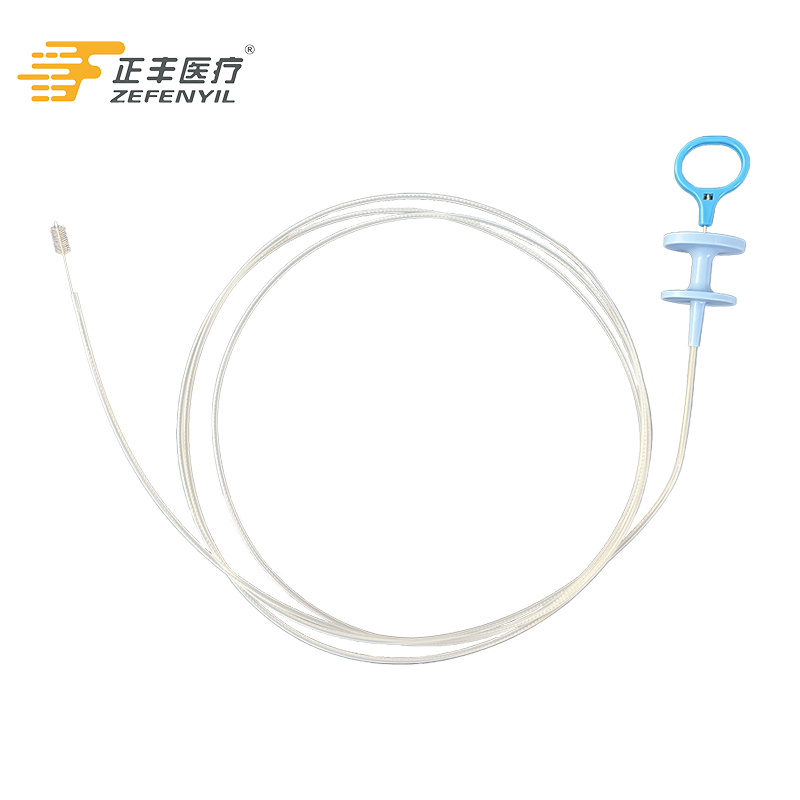
Core Types of Gastroenterology Surgical Instruments
The range of instruments used in gastrointestinal endoscopy has expanded significantly over the past two decades. Each tool addresses a specific procedural need, and understanding the main categories is the starting point for both clinical planning and procurement decisions.
Biopsy Forceps
Biopsy forceps are among the most frequently used instruments in diagnostic endoscopy. Passed through the endoscope's working channel, they open their cup-shaped jaws at the target site, bite a small tissue sample, and retract for histopathological analysis. Hot biopsy forceps combine tissue sampling with electrosurgical coagulation for simultaneous sampling and hemostasis. Cup size typically ranges from 5 to 8 mm, and selection depends on the target tissue depth and location.
Polypectomy Snares
A polypectomy snare is a wire loop extended beyond the tip of a flexible sheath. The endoscopist positions the loop around the base of a polyp, tightens it, and applies electrosurgical current to resect and simultaneously coagulate the stalk. Snares are available in oval, hexagonal, crescent, and barbed configurations — each suited to different polyp morphologies, from small pedunculated lesions to broad-based sessile polyps. Cold snare polypectomy, performed without electrosurgical current, has gained adoption for small polyps due to its lower risk of delayed bleeding.
Endoscopic Hemostasis Devices
Gastrointestinal bleeding demands rapid, reliable intervention. The instrument category covers several mechanisms: hemostatic clips (through-the-scope clips that mechanically close bleeding vessels), injection needles for submucosal epinephrine or sclerosant delivery, and coagulation probes that apply thermal energy to the bleeding point. Modern through-the-scope clips are engineered to be compatible with standard 2.8 mm working channels, making them accessible in both diagnostic and therapeutic endoscopes without equipment change.
Endoscopic Injection Needles
Injection needles deliver agents — saline, epinephrine, contrast, or submucosal lifting solutions — directly to the target site through the endoscope channel. In endoscopic mucosal resection (EMR) and endoscopic submucosal dissection (ESD), submucosal injection creates a fluid cushion that lifts the lesion away from the muscularis, making resection both easier and safer. The needle gauge and sheath flexibility are selected to match the target anatomy and injection volume required.
Biliary and GI Stents
Stents — both plastic and self-expanding metal — are placed endoscopically to maintain patency in obstructed bile ducts, pancreatic ducts, esophagus, duodenum, or colon. Stent placement is now the standard first-line approach for malignant strictures and selected benign obstructions, offering a minimally invasive alternative to surgical bypass. Dedicated delivery systems ensure accurate deployment under endoscopic or fluoroscopic visualization.
Guidewires and Catheters
Guidewires and catheters are the navigational infrastructure of therapeutic endoscopy. A guidewire is advanced through a stricture or into a duct first, then used to guide catheters, dilating balloons, or stent delivery systems to the target site. Wire diameter (0.018 inch, 0.025 inch, 0.035 inch) and stiffness are matched to the specific access route and resistance expected.
Guanchuang's full range of gastroenterology surgical instruments covers these core categories with both standard and custom configurations available for OEM and ODM requirements.
Minimally Invasive vs. Traditional Open Surgery
The shift from open surgery to endoscopic intervention in gastroenterology is one of the most consequential changes in modern medicine. For patients and clinicians alike, the advantages are concrete and well-documented.
Less Tissue Damage
Endoscopic instruments reach the target through natural body openings. There is no abdominal incision, no muscle cutting, and no need to move organs aside to access the surgical site. The tissue disruption is confined to the lesion itself — not the surrounding anatomy.
Faster Recovery
Without a surgical wound to heal, recovery times compress dramatically. Many endoscopic GI procedures are performed as day cases or require only overnight observation. Patients who would require weeks of post-operative recovery after open surgery are often discharged within 24 to 48 hours following endoscopic treatment.
Fewer Complications
Open abdominal surgery carries established risks: wound infection, adhesion formation, prolonged ileus, and anesthesia-related complications. Endoscopic procedures avoid all wound-related complications and, with modern instrument design, have significantly reduced rates of perforation and bleeding compared to historical benchmarks.
High Safety Profile for High-Risk Patients
This is arguably the most clinically significant advantage. Elderly patients, those with multiple comorbidities, anticoagulated patients, or critically ill patients who cannot tolerate general anesthesia or laparotomy are frequently excellent candidates for endoscopic intervention. Endoscopic gastroenterology surgical instruments make treatment accessible to patients who would otherwise have no safe surgical option.
Electrosurgery instruments for endoscopic hemostasis
Bleeding control during endoscopy has been transformed by dedicated electrosurgical tools. Guanchuang's electrosurgery instruments for endoscopic hemostasis deliver precise monopolar or bipolar energy to the bleeding site, coagulating vessels with minimal spread to surrounding tissue — a level of control that rivals open surgical hemostasis in most upper and lower GI bleeding scenarios.
Lower Total Cost of Care
Shorter hospital stays, reduced complication management, and avoidance of general anesthesia and full operating room resources all translate into lower total cost per episode of care. For healthcare systems managing high volumes of GI disease, the economic argument for endoscopic intervention is compelling alongside the clinical one.
Clinical Applications Across the GI System
Gastroenterology surgical instruments are not organ-specific — they operate across the full length and breadth of the digestive system. The specific instruments deployed shift with the anatomy and the pathology being treated.
Esophagus
Esophageal applications include biopsy of suspected Barrett's esophagus or esophageal carcinoma, dilation of benign strictures using balloon dilators, stent placement for malignant obstruction, and endoscopic mucosal resection of early-stage lesions. Hemostatic clips and injection needles manage bleeding from esophageal varices in combination with band ligation devices.
Stomach and Duodenum
Gastric polyp removal, biopsy of mucosal lesions, and treatment of upper GI bleeding (peptic ulcer hemorrhage, Dieulafoy lesions, post-procedural bleeding) are the dominant instrument uses in the stomach. Endoscopic submucosal dissection allows en-bloc resection of early gastric cancer without open gastrectomy. In the duodenum, guidewires and catheters access the biliary and pancreatic orifice for ERCP procedures.
Liver, Bile Duct, and Pancreas
ERCP (endoscopic retrograde cholangiopancreatography) is one of the highest-complexity applications of GI endoscopic instruments. Sphincterotomes cut the biliary sphincter, stone extraction balloons and baskets retrieve bile duct stones, and biliary stents manage strictures caused by cholangiocarcinoma, pancreatic cancer, or post-surgical anatomy. Endoscopic ultrasound-guided procedures extend instrument access into the liver and pancreatic parenchyma itself.
Colon and Rectum
Colonoscopy drives the largest volume of gastroenterology instrument use globally. Polypectomy snares and biopsy forceps are the workhorses of colorectal polyp management and cancer screening. Hemostatic clips manage post-polypectomy bleeding. Submucosal injection enables EMR of large flat lesions. Colonic stenting provides palliation for malignant obstruction or bridges patients to elective surgery.
Why Disposable Design Matters in Modern Endoscopy
Reusable endoscopic accessories were standard practice for decades. The shift toward single-use, disposable instruments is no longer a trend — it is becoming the clinical and regulatory expectation in high-standard healthcare environments.
Infection Control
Reusable accessories require meticulous reprocessing between patients. Biopsy forceps, injection needles, and snares have complex internal geometries — fine wire braids, articulating cup hinges, needle lumens — that are difficult to clean completely. Retained organic material creates infection transmission risk. Single-use instruments eliminate reprocessing entirely: each patient receives a sterile, uncompromised device from packaging to procedure to disposal.
Consistent Performance
Reusable instruments degrade with each use and reprocessing cycle. Wire snares lose their shape. Forceps cups dull. Spring mechanisms weaken. A disposable instrument performs at the same specification every time — critical in procedures where precise tip control and reliable opening force directly affect procedural outcome and patient safety.
Regulatory and Liability Clarity
Single-use labeling provides clear traceability. Each instrument has a defined sterility shelf life, a lot number, and a single patient of record. For hospitals navigating joint commission standards, infection control audits, and adverse event investigations, the documentation simplicity of disposable instruments reduces institutional risk.
Guanchuang specializes in the design and manufacture of disposable endoscopic and laparoscopic instruments built to meet the sterility, performance, and traceability standards demanded by hospitals and distributors in regulated markets across Europe, North America, and beyond.
Key Considerations When Selecting Gastroenterology Surgical Instruments
Procurement decisions for endoscopic instruments involve more than catalog browsing. The following criteria determine whether an instrument performs as expected in the clinical environment where it will be used.
Endoscope Compatibility
Every instrument must fit the working channel diameter of the endoscopes in your facility. Standard diagnostic endoscopes typically have 2.8 mm channels; therapeutic endoscopes offer 3.2 mm or 3.7 mm channels for larger instruments. Confirm channel compatibility before ordering, as an incompatible instrument is useless regardless of its other specifications.
Material Safety and Biocompatibility
All components that contact patient tissue must meet biocompatibility standards (ISO 10993). Stainless steel grades, polymer sheath materials, and any coatings or lubricants must be validated for intraluminal use. For instruments that deliver electrosurgical energy, electrical insulation integrity across the full shaft length is a non-negotiable safety requirement.
Precision and Tactile Feedback
The endoscopist operates the instrument through a handle mechanism at the proximal end while the working tip is potentially a meter away inside the patient. The mechanical linkage between handle action and tip response must be reliable, responsive, and accurate. Poor tip control in a polypectomy snare or a hemostatic clip is not just a performance issue — it is a patient safety issue.
Sterility Assurance and Shelf Life
Single-use instruments must maintain sterility through shipping, storage, and handling until the moment of use. Packaging integrity, validated sterilization method (EO gas, gamma, or e-beam), and appropriate shelf life must be confirmed and documented by the manufacturer.
Regulatory Certification
For hospital procurement in regulated markets, instruments must carry the appropriate regulatory clearance — CE marking for Europe, FDA 510(k) clearance for the United States, or equivalent national approvals. Verify the specific certificate covers the intended use and device configuration, not just the manufacturer's general quality system. Guanchuang's quality certifications and manufacturing standards reflect our commitment to meeting these requirements across our full product portfolio.
Guanchuang: Your OEM/ODM Partner for Endoscopic GI Instruments
Jiangsu Guanchuang Medical Technology Co., Ltd. has built its reputation on one capability: manufacturing gastroenterology and endoscopic surgical instruments to the precision, sterility, and regulatory standards that hospital procurement teams and medical device distributors require — with the flexibility to do it under your brand.
Our OEM and ODM services cover the full instrument development cycle. From initial design consultation and prototype development through regulatory documentation, sterile packaging, and volume production, Guanchuang manages the process so our partners can focus on their markets. Whether you need a standard biopsy forceps produced to your catalog specification, or a custom snare configuration designed for a specific procedural application, our engineering and manufacturing teams are structured to deliver both.
The combination of in-house manufacturing capability, quality management systems aligned with international medical device standards, and deep experience across the gastroenterology instrument category makes Guanchuang a reliable long-term production partner — not just a supplier. To discuss your OEM/ODM requirements or request samples, explore our OEM/ODM custom surgical instrument services.

- ลิงค์ด่วน
- About Us
- Quality
- Service
- News
- Contact us
- ผลิตภัณฑ์ของเรา
- เครื่องมือส่องกล้องส่องกล้องแบบใช้แล้วทิ้ง
- การปิดแผลแบบใช้แล้วทิ้ง
- เครื่องมือผ่าตัดทรวงอก
- เครื่องมือไฟฟ้าศัลยกรรม
- เปิดเครื่องมือผ่าตัด
- เครื่องมือผ่าตัดบริเวณทวารหนักทางเดินปัสสาวะ
- เครื่องมือผ่าตัดระบบทางเดินอาหาร
- อุปกรณ์เสริมทางการแพทย์
- อุปกรณ์เตรียมเลือด
- ติดต่อเรา
- Tel:+86-519-69878833
- Phone:+86-13584319056
- E-mail:[email protected]
- Address:อาคาร 2D, 2C และ 3C, สวน Pioneer Sci-tech Wujin, เลขที่ 256 ถนน Middle Mingxin, เมือง Hutang, เขต Wujin, Changzhou, 213164 Jiangsu P.R. China

